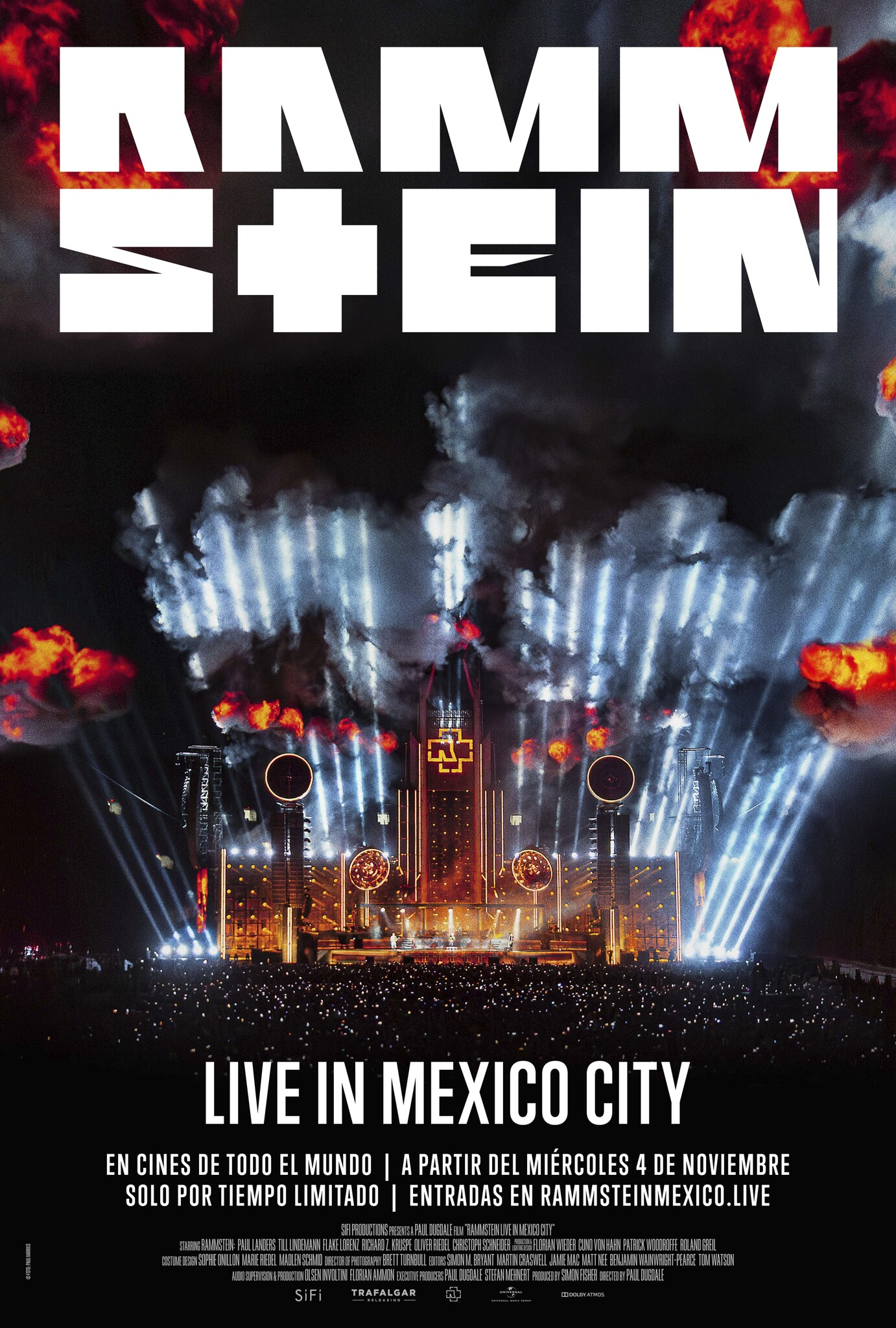


There’s something strange about watching Rammstein in a movie theater. You sit in a padded seat, popcorn in hand and air conditioning humming, facing the image of sixty-five thousand sweat-soaked people at Mexico City’s Foro Sol while Till Lindemann holds two flamethrowers as if they were part of his body, and the distance between one experience and the other seems impossible to close. ‘Live In Mexico City’ doesn’t close it completely, no film could, but it gets closer than I expected, and for anyone who lived through one of those concerts or missed out on them, it feels almost personal.
The footage comes from the three nights the band played at the Foro Sol on October 1, 2 and 4, 2022, in front of nearly two hundred thousand people in total, as the finale of the only North American leg of their stadium tour, which had kicked off in Montreal that August. That Rammstein chose precisely those dates for the great live document of their stadium era, over the US shows or the two 2019 nights in Vienna that were also filmed, says a lot about what they saw that October. Four years later the film reaches cinemas worldwide for a limited run, and on November 20 it’s released as a double album, a Blu-ray and a series of physical editions that range from a quadruple vinyl to a box with a lucha libre mask.
The most important change compared with ‘Rammstein: Paris’ is behind the camera. That 2017 film, directed by Jonas Åkerlund, was a whirlwind of frantic cuts that at times made me dizzier than it moved me. Here the director is Paul Dugdale, a concert specialist who has worked with Adele, The Rolling Stones, Taylor Swift and Coldplay, and his approach is far more patient: long, fluid takes, wide shots that let the stage breathe and editing that only speeds up when the music demands it. For the first time in a long while, I felt I was watching a Rammstein concert and not a two-hour music video.
That patience has an immediate effect: the crowd. Dugdale gives the audience a prominence I don’t remember in any other live record of the band, and he does it with an almost documentary instinct, jumping from the band to a face in the crowd for a few seconds, to a group of friends with their arms around each other, to someone filming on their phone without realizing they’re being filmed themselves. At the screening I went to, those moments drew laughs and applause, and I understood that the film is as much about the Foro Sol as it is about the band.
‘Armee Der Tristen’ opens after Handel‘s ‘Music For The Royal Fireworks’ serves as the intro, and the camera takes its time to show the scale of the industrial city that is the stage. ‘Links 2-3-4’ is one of the moments where Dugdale does break his own calm, with a shaky camera that perfectly conveys the force of thousands of people marching at once, and ‘Mein Herz Brennt’ does exactly the opposite, slowing the editing and letting the whole stadium sing. That’s the song where the hairs on my arms first stood up.
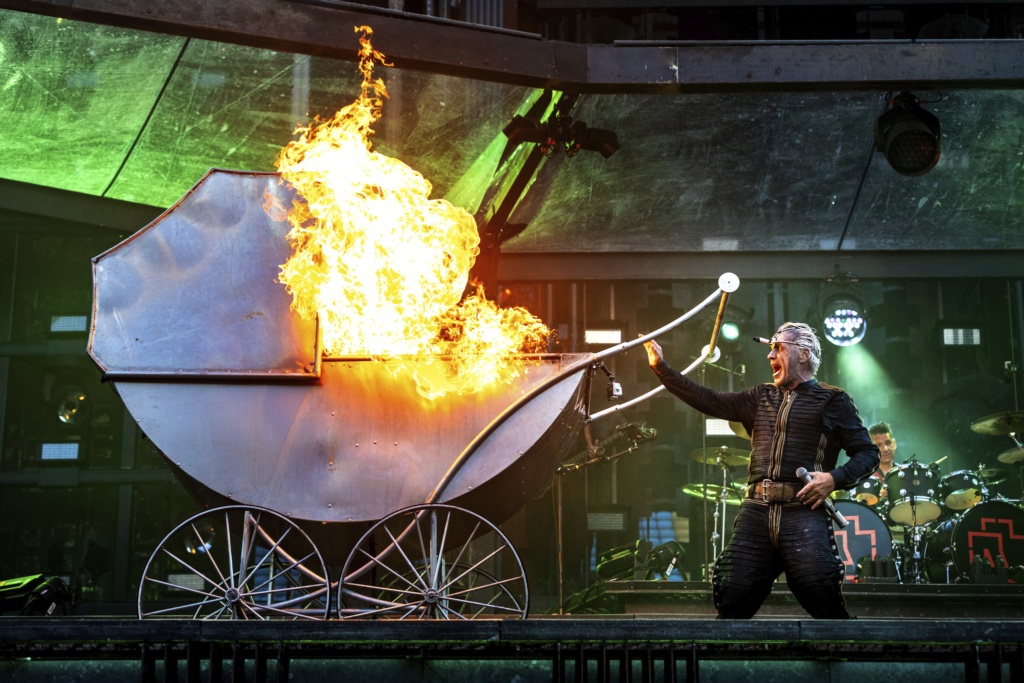
What surprised me most is Lindemann. I had never seen him enjoy the stage this much in any live recording, and the film makes sure we notice: the whispers between songs come through with almost uncomfortable clarity, his gestures read in close-up and there’s a complicity with the audience that at other points in his career seemed impossible. In ‘Mein Teil’, as he’s handed the flamethrowers and delivers his remarks each time, the film hits one of its peaks, a perfect mix of theater, black humor and menace that sums up Rammstein better than any explanation.
The sound deserves a special mention. The mix, worked on by engineer Svante Forsbäck and already reported as under way by Richard Kruspe in May 2025, is probably the best a Rammstein live release has ever had: the guitars carry the weight they should, Flake‘s keyboards stand out without getting lost in the mass, and the crowd is present without covering anything up. It’s worth seeking out a Dolby Atmos screen, because the difference is huge, although the experience depends heavily on the theater, and at some screenings the volume falls short for something that ought to be felt in your chest.
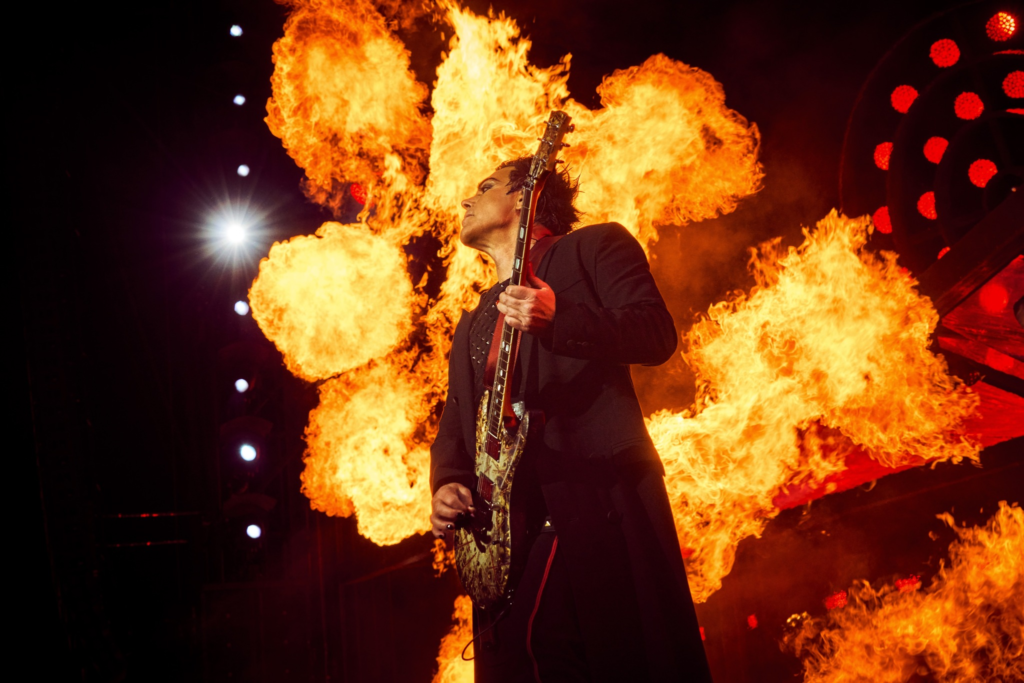
The pyrotechnics look spectacular on screen, including the two extra turrets installed in the pit just for these shows, but this is where the natural limit of any Rammstein film appears. In ‘Sonne’ or ‘Du Hast’ the flames fill the screen, and still the essential thing is missing: the heat. Anyone who has been to one of the band’s concerts knows that the fire isn’t seen, it’s felt on your face, and no 4K camera can reproduce that. It isn’t a flaw of the film, but it does explain why at times I felt more like a spectator than a participant.
The B-stage stretch is the most uneven. ‘Engel’, in a piano version with a piano duo, worked beautifully in the stadium, where thousands of phones lit up the Foro Sol, but on screen it feels flat, and it’s the only moment where the film loses steam. ‘Ausländer’ and ‘Pussy’ bring back the party energy, and the return to the main stage with ‘Rammstein’ and ‘Ich Will’ takes the film back to its highest point.
And then comes ‘Adieu’, which for me is the most emotional moment of the entire film. It’s a farewell song, and seeing it in that context, with the Foro Sol lit up and the band leaving the stage little by little, carries a weight I didn’t expect. The piano version of ‘Sonne’ that follows, with the lift raising the musicians above the stadium, closes the concert with an image that could be the cover of this whole chapter of the band.
But the best part comes after the credits. ‘Te Quiero Puta!’, the Spanish-language song from 2005’s ‘Rosenrot’ that Rammstein almost never play live, which returned on those nights as a gift to the Mexican crowd after the audience refused to let them go, appears as the final scene, with fans posing for the camera. It’s the funniest moment of the film, the most Mexican and, honestly, the reason it’s worth staying in your seat until the lights come up. Those were the nights when Lindemann told the crowd “México, increíble, muchísimas gracias” and when Kruspe ended up with a Dr. Simi plush toy, the mascot of a Mexican pharmacy chain, hanging from his guitar strap, and that mix of German solemnity and local chaos is in this film’s DNA.
I have two reservations. The first is that the cinema version leaves out several songs from the full setlist, which only appear in the extended 142-minute Blu-ray cut, and there’s no clear explanation of why. The second is that there’s nothing beyond the concert: no interviews, no backstage scenes, not a single word from the band about what those nights meant. I understand that Rammstein prefer to let the music speak for itself, but for a document so tied to a specific place and audience, I was left wanting to know what they saw from the stage.
The film opened in theaters worldwide on November 4 for a limited run through Trafalgar Releasing, and it’s worth remembering that those 2022 dates were the band’s only full-scale stadium production in North America: twelve open-air shows that started in Montreal, crossed seven US stadiums and ended at the Foro Sol. On November 20 come the double album, the Blu-ray with the extended cut in Dolby Atmos, the quadruple vinyl, which also comes in a colored edition with the three hues of the Mexican flag, and a deluxe edition with a photo book of almost three hundred pages, while March 19, 2027 brings the Lucha Libre Head & Mask Edition, limited to six thousand copies, with a resin head of one of the six members and a wrestling mask. That the band turned lucha libre and the colors of the Mexican flag into part of the packaging says a lot about what those nights meant to them, and as a collector’s item it’s one of the most fun things Rammstein have ever released.
‘Live In Mexico City’ is Rammstein’s best concert film, clearer, better directed and better mixed than ‘Paris’, and a very faithful portrait of a band at the top of its game in front of one of the audiences that loves it most. It doesn’t replace the experience of being there, nor does it try to, but it honors it. ‘Mein Teil’, ‘Mein Herz Brennt’, ‘Adieu’ and that closing ‘Te Quiero Puta!’ more than justify the ticket, and anyone who sees it in a theater with a good sound system will walk out feeling they were, at least a little, at the Foro Sol.