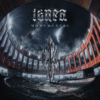

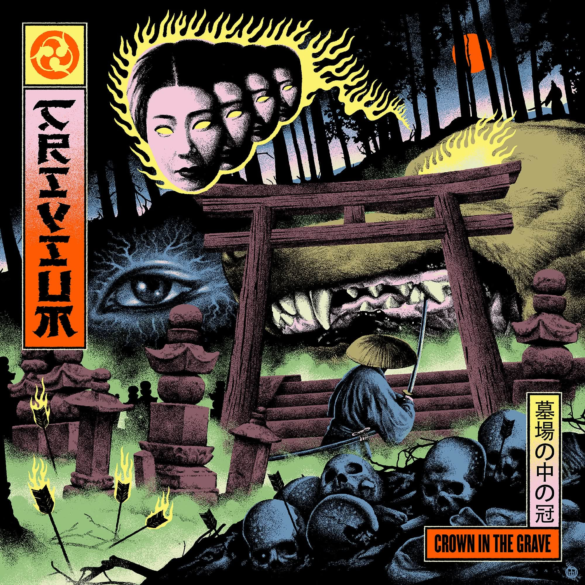
Few bands have had a decade as good as Trivium‘s. Since 2017’s ‘The Sin And The Sentence’ they strung together three albums that put them in the front row of modern metal, and I came to ‘Crown In The Grave’ suspecting that sooner or later that streak had to break. The signs weren’t great: in October 2025 they parted ways with Alex Bent, the drummer who had been the engine of that whole era, and the band spent months regrouping. After a week with the record I can say the streak didn’t break, although it changed shape, and that this eleventh album is less a triumph of speed than one of character.
The change starts with where it was made. It’s the first album the band wrote and recorded at The Hangar, their own space in Orlando, with Josh Wilbur back as producer and Jacob Hansen handling the mix for the first time. The new drummer is Alex Rüdinger, whom everyone calls Rüdi, who nearly joined the band in 2015 and who here doesn’t just play but writes. That the change of drummer is so hard to notice is probably the highest praise you can give him: Rüdinger sounds like he’s been there for years, with a relentless right foot and a way of filling the gaps that holds the whole record up.
The other big engine is Japan. Matt Heafy was born in Iwakuni to a Japanese mother, and his heritage had already surfaced on ‘Shogun’, but here the concept is deeper and darker. The band took Akira Kurosawa‘s ‘Throne Of Blood’, his version of ‘Macbeth’, as their compass and immersed themselves in Japanese horror cinema from the fifties to the seventies, in Noh theater and in ghost folklore. The result isn’t an exotic costume but an atmosphere that tints the whole album, and one of the record’s biggest achievements is that those influences blend in without ever interrupting the punch of the songs.
‘Jorōgumo’, named after the spider woman of Japanese legend, opens with Japanese fiddle, mouth organ and shakuhachi building a slow tension that spills into the title track. ‘Crown In The Grave’ is classic Trivium, with huge riffs, vocals alternating between growls and clean singing and a chorus made to be shouted, but it sounds darker and more measured than on other records, with space between the riffs instead of a constant avalanche. It’s the clearest bridge to the ‘Ascendancy’ and ‘In Waves’ era, and it works as a perfect introduction to what’s coming.
‘Dead Inside Of Me’ was the one that surprised me most and the one that took me longest. It has a fat bass and a heavy gait that put it close to Slipknot and even Korn, and some people will find it too commercial. It ended up winning me over with its lyrics, which take Japanese ideas about public masks and inner conflict to talk about Heafy’s mental health, and with a chorus that hits incredibly hard. Heafy has said that on this record he decided to just sing after years of anxiety and therapy, and you can hear that honesty.
‘The Terror’ is my favorite and, according to the band, the song that changed the album’s direction. It was the first one they wrote with Rüdinger, under pressure before a tour, and it’s the only one that leaves Japanese horror behind to talk about what they themselves went through during that uncertain period. It’s fast, with a melodeath core, a huge refrain and a Corey Beaulieu solo that at moments reminded me of Michael Amott. When I first heard it I immediately pictured an arena chanting it back, and I don’t think it’ll take long to become a live classic.
‘The Haunting Never Ends’ drops the tempo slightly and grows with repeated listens, with a low, grinding guitar and spectacular closing fills, and ‘Lie Of It All’ is more restrained, with soft verses, gorgeous vocal harmonies, a gothic mood that suits Heafy’s baritone perfectly and an obvious nod to Megadeth. Paolo Gregoletto cited ‘The Black Album’, ‘Countdown To Extinction’ and ‘Superunknown’ as reference points for this record, and it’s on songs like this one that the pursuit of big choruses and compact structures is most noticeable.

‘Blackout The Dawn’ is the riskiest move and, for me, one of the album’s best moments. It starts with acoustic guitar and Japanese string instruments, Gregoletto’s bass has a beautiful tone and the song builds to a very catchy hook without ever losing its delicacy. It’s probably the best ballad the band has written, and yes, it’s more radio-friendly than almost anything they’ve done, but it doesn’t sound like a concession; it sounds like a band finally comfortable letting its guard down.
This is also where my main reservation lies. After ‘Blackout The Dawn’ comes ‘Paradise Of Sinners’, a solid song with a powerful bass line and an opening line from Heafy delivered in a very James Hetfield fashion, but it lands in a stretch where the album’s pacing starts to weigh. After three albums of almost constant speed, ‘Crown In The Grave’ asks the listener to settle into a more measured pace, and in the middle of the record I missed some of the operatic, overflowing grandeur of ‘In The Court Of The Dragon’.
‘Death Throes’ rescues the momentum with an aggressive groove, gang chants built for the pit and a fusion of melodic death metal and thrash that recaptures the spirit of ‘Shogun’. ‘The Agony’ opens with an almost nu-metal feel that throws you for a few seconds before turning into a heavy anthem, with Heafy exploring his lowest registers, and ‘Devour Your Dreams’ is the most progressive song of the final stretch, with colliding riffs and a high chorus that stuck with me. That stretch even features the voices of Heafy’s twins, a small detail that gives the close a more intimate tone.
‘Serpent In The Flame’ is the only song over five minutes and the best closer a Trivium album has had in a long time. It’s an epic anthem driven by Rüdinger’s double bass, with a terrific guitar solo and a momentum that’s begging for a circle pit, and it made me think of ‘Shogun’ in the same way the title track had made me think of ‘Ascendancy’. It’s the kind of ending that makes you want to put the record on again from the start.
Sonically, Wilbur’s production and Hansen’s mix are among the best the band has ever had: clear, powerful, with room for every instrument to breathe and a bass that finally carries the weight it deserves. Heafy is perhaps at the vocal peak of his career, more versatile than ever and less reliant on screaming, and the chemistry between the four feels renewed, as if the change of drummer had forced them to rediscover each other.
The band is already taking the record on the road with a North American headline run that kicked off November 5 in St. Petersburg, Florida, with In Flames, Orbit Culture, Fit For An Autopsy and Frozen Soul, and still has stops at Chicago’s Aragon Ballroom, Houston’s Bayou Music Center, Dallas’ South Side Ballroom, the YouTube Theater in Inglewood, The Masonic in San Francisco and Seattle’s Paramount Theatre before closing December 19 at The Fillmore Charlotte. Canadian fans get their turn on December 8 at Vancouver’s Doug Mitchell Thunderbird Sports Centre, and in spring 2027 the band heads to mainland Europe with In Flames, Paleface Swiss and VOLA, playing arenas such as the Zénith in Paris, Berlin’s Velodrom, Amsterdam’s AFAS Live, Vienna’s Stadthalle and Stockholm’s Avicii Arena. After hearing ‘The Terror’ and ‘Serpent In The Flame’, I have little doubt this material will grow enormously live, and Rüdinger looks like the ideal drummer to hold it together night after night.
‘Crown In The Grave’ isn’t Trivium’s fastest or most ambitious album, and anyone looking for the overflowing intensity of their recent trilogy may feel the middle of the record stalls a little. But it’s their most personal work, the most aesthetically coherent and probably the best produced, the album of a band that went through a crisis and came out talking about it without losing its edge. ‘The Terror’, ‘Blackout The Dawn’, ‘Crown In The Grave’ and ‘Serpent In The Flame’ are among the best things they’ve recorded, and eleven albums in, that says a lot.
