Luxury fashion and rock music have needed each other for more than fifty years. Fashion houses look to musicians for something no atelier can manufacture: the credibility of a subculture, the idea of rebellion, the aura of someone who walks onstage in front of thousands of people. Musicians, in turn, have found in designers a way to turn an image into a character, and in the big houses a kind of legitimacy and an audience the rock circuit didn’t always offer. The relationship has changed shape with every generation, and following it is also a way of tracking how an aesthetic born on the margins ended up in the most expensive store windows in the world.
In the ’70s, Kansai Yamamoto and Vivienne Westwood made the clothes David Bowie and the Sex Pistols built their identities around. In the ’90s and 2000s, Alexander McQueen and Hedi Slimane brought designer tailoring on tour and turned the rock star’s silhouette into the foundation of menswear. Then the houses started casting rock stars as campaign faces and borrowing metal’s iconography, all the way up to official collaborations: Metallica with Brioni, Rammstein with Balenciaga, Iron Maiden with Represent. The latest chapter came in March 2026, when Marilyn Manson opened the Enfants Riches Déprimés show in Paris, a label founded in Los Angeles and now opening in New York.
Kansai Yamamoto and the Making of Ziggy Stardust
The first great partnership between a designer and a rock star began in London in 1971. That year, Kansai Yamamoto became the first Japanese designer to stage a collection there, in a show where models mimicked kabuki movements and the clothes borrowed that theater’s intense colors and sense of spectacle. Kansai wanted to prove Japanese aesthetics could hold their own on the world stage, and Harpers & Queen backed him up with a cover and a six-page spread.
Bowie was primed to get it. In the ’60s he had studied dance with Lindsay Kemp, whose work drew on kabuki, and he admired the onnagata, the male actors who play female roles in that tradition, a figure that fit his interest in blurring gender lines. He bought pieces from the 1971 collection, including the ‘Woodland Creatures’ jumpsuit, and later admitted that the Ziggy Stardust haircut was “taken lock, stock and barrel from a Kansai display in Harpers.” The Japanese-inspired costumes made their live debut at London’s Rainbow Theatre on August 19 and 20, 1972.
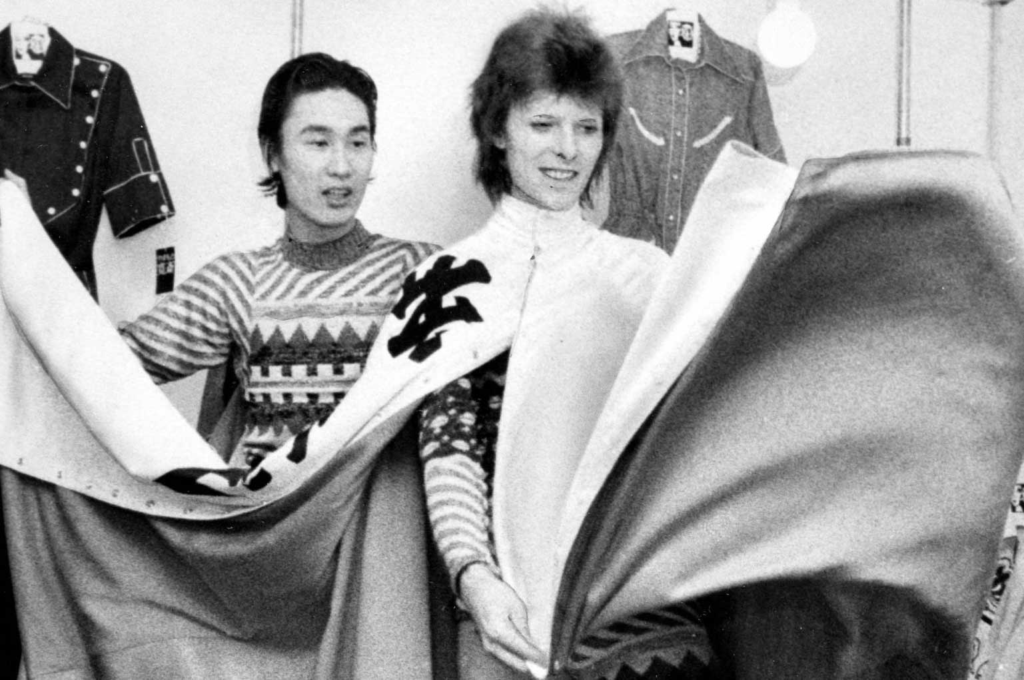
Designer and singer met in person in February 1973, after Bowie played Radio City Music Hall in New York. They were introduced by Kansai’s stylist Yasuko Hayashi, who was already working with photographer Masayoshi Sukita on Bowie’s shoots. What came out of it was the wardrobe for the 1973 leg of the Ziggy Stardust tour, the one behind ‘Aladdin Sane’: a black vinyl jumpsuit with white stripes and enormous legs adapted from the hakama, the traditional Japanese trouser, known as ‘Tokyo Pop’; a white cape covered in kanji; a blue, black and red outfit based on the loose trousers worn by samurai. Bowie also borrowed kabuki’s quick costume change: some outfits were torn off him mid-show using hikinuki, with stagehands yanking one costume away to reveal another underneath.
What emerged was more than a wardrobe. For the first time, a rock persona was being built in direct conversation with a fashion designer, and the clothes became part of the story. “David was a true vanguard—he was making waves in the musical landscape of the time,” Kansai said, and he never forgot what he saw: the image of Bowie in his costume “has been chiselled in my brain with unfading vividness.” The designer died in July 2020 at 76. The ‘Tokyo Pop’ jumpsuit, originally black and now faded to light gray, is held by London’s Victoria and Albert Museum.
Vivienne Westwood, Malcolm McLaren and Punk as a Collection
While Bowie was becoming Ziggy, Vivienne Westwood and Malcolm McLaren were reinventing their shop at 430 King’s Road in London every couple of years. In 1971 it was Let It Rock, selling records and memorabilia from ’50s rock ‘n’ roll as a tribute to the Teddy Boys; that’s where Westwood started making her own clothes. In 1972 it became Too Fast to Live, Too Young to Die and went biker, with zips, studs, leather and a skull and crossbones logo. In 1974 it turned into SEX, with pink padded letters on the front and rubber, PVC and fetish wear inside; a T-shirt showing two naked cowboys led to a police raid and the couple’s arrest for “indecent exhibition.”
The music connection ran backward from the usual order. In 1975, McLaren started managing a new band to spread the word about the shop and named it after the store: the Sex Pistols. Bassist Glen Matlock worked there as a sales assistant, and the band wore the shop’s clothes. Put another way, the most important band in British punk began, in part, as a marketing play for a clothing store. In 1976 the shop changed again and became Seditionaries, where Westwood combined bondage gear, leather, chains, ripped fabric and tartan. That mix, along with safety pins, torn shirts, bondage pants and T-shirts carrying provocative slogans, became punk’s uniform.
Westwood never hid what she was after. She said she wanted her clothes to “cause a confrontation,” and in 2009, asked whether she regretted the extreme imagery she used back then, she said no, because the point was to reject the older generation’s values: “We don’t accept your values or your taboos.” In 1980 the shop became Worlds End, the name it still carries, with its giant clock spinning backward.
Westwood’s later career is the clearest proof that punk could enter high fashion without losing its roots. The designer who dressed the Sex Pistols went on to show on the runways of London, Paris, Milan and New York, and her work sits in museum collections around the world. Andrew Bolton, curator of the Costume Institute at New York’s Metropolitan Museum of Art, credited her with pioneering the punk look and pairing it with the Sex Pistols’ sound. Westwood died on December 29, 2022, at 81.
Bowie, McQueen and Hedi Slimane: Tailoring Takes the Stage
Two decades after Ziggy, Bowie went looking for a young designer to redefine him again. In 1996, after reading about Alexander McQueen, he commissioned a frock coat made from the Union Jack, deliberately distressed with tears, burns, stains and wax, lined in red satin and fitted with a padded bustle sewn inside the tails. The collar carries McQueen’s label and a lock of brown hair encased in Perspex, one of the designer’s early signatures. Bowie wore it at the 1996 summer festival dates of the ‘Outside’ tour, at the 1997 VH1 Fashion Awards, as the opening look of the ‘Earthling’ tour that year and on the cover of ‘Earthling’, shot by Frank Ockenfels.
The flag was a deliberate choice. In the mid-’90s, the Union Jack was the emblem of Britpop and a kind of cultural nationalism sold on T-shirts and magazine covers. Bowie wore it torn and scorched, and called the piece “the ultimate anti-icon.” The V&A, which acquired the outfit in 2024, credits it jointly to Bowie and McQueen, a rare acknowledgment of how involved the musician was in creating his own wardrobe. McQueen died in February 2010, and the coat remains one of the clearest records of his ties to rock.
The designer who wove rock most deeply into menswear was Hedi Slimane. From 2000 to 2007, as creative director of Dior Homme, he pushed a skinny silhouette of narrow suits and drainpipe pants lifted straight from musicians. In 2002 he designed the black suits for Bowie’s ‘Heathen’ tour, and that same year Bowie personally presented him with the CFDA International Award, making Slimane the first menswear designer to win it. Beyond Bowie, he dressed Mick Jagger, Jack White, The Kills, Beck, Franz Ferdinand and Daft Punk for the stage, and soundtracked his shows with young bands like Razorlight, The Rakes and These New Puritans.
Slimane didn’t just dress musicians; he documented them. In 2004 he published ‘Stage’, a photo book on that era’s rock revival, and the same year made custom Dior Homme pieces for Carl Barât and Pete Doherty of The Libertines. In 2005 he devoted ‘London: Birth of a Cult’ to Doherty, Babyshambles and the London scene. His work locked in an idea that ruled menswear for a decade: the suit was no longer cut for an executive, but for someone who might be onstage that night.
He carried that logic to every house he led. Back at Saint Laurent from 2012 to 2016, he launched the Saint Laurent Music Project, a series of portraits of musicians wearing pieces from the current collection that they styled themselves. The April 2013 installment brought together Marilyn Manson, Courtney Love, Kim Gordon and Ariel Pink, following an earlier round with Beck, Sky Ferreira and Christopher Owens, and later added names like Joni Mitchell. At Celine, where he worked from 2018 to 2024, he supplied Keith Richards‘s 2019 tour wardrobe, which debuted at the opening show of The Rolling Stones‘ North American run in Chicago.
From Campaign Faces to Metal on the Runway
In the 2010s, the relationship moved into a new phase: the rock star as campaign face. Gucci, under creative director Alessandro Michele from 2015 to 2022, understood that better than most. In December 2015 the house named Jared Leto of Thirty Seconds to Mars the face of the Gucci Guilty fragrance, with a campaign shot in Venice. “He is a true creative genius, a real artist and a very special person,” Leto said of Michele. At the 2019 Met Gala in New York, he arrived in Gucci carrying a replica of his own head, a nod to the fake heads models carried on the brand’s Fall 2018 runway.
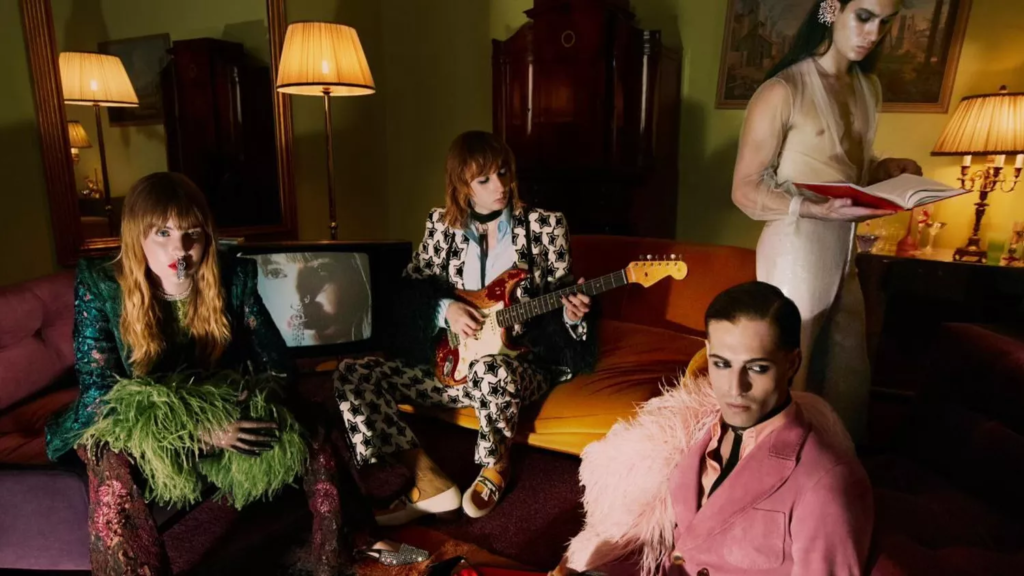
Måneskin showed how the formula worked with a young band. In September 2021, months after winning Eurovision, the Italians fronted the campaign for Gucci Aria, the house’s centennial collection, shot by Mert & Marcus with a cast chosen by Michele himself. They posed in androgynous looks from the Fall 2021 collection, having already appeared in Gucci in the ‘I Wanna Be Your Slave’ video, wearing floral suits, pink taffeta dresses, black lace lingerie and a leather jacket emblazoned with the word “Puppet.”
At the same time, metal’s iconography began slipping onto runways without the bands involved. In 2012, Nicolas Ghesquière‘s Balenciaga showed a black satin sweatshirt lettered in the style of the Iron Maiden logo. For Spring/Summer 2016, Demna‘s label Vetements set Bathory-style fonts next to the Department of Homeland Security logo, an Ikea bag and McDonald’s golden arches, a wink at mass culture’s appropriation of the look. That same season, Riccardo Tisci based Givenchy‘s Fall/Winter 2016 menswear on ‘Botswana Renegades’, photographer Frank Marshall‘s series on the metalheads of Botswana, who pair band T-shirts with biker leathers, Western fringe and cowboy hats. “I looked in the book and saw these gangs, their freedom – it was something very new for me,” Tisci said.
In those years, band tees also became a celebrity and fast-fashion phenomenon, with chains selling Black Sabbath, Slayer and Mötley Crüe designs to buyers who often didn’t know the bands. That wave set up what came next. Fashion houses stopped borrowing metal’s look from the outside and started negotiating with the bands themselves.
Metallica, Rammstein and Iron Maiden Sign On
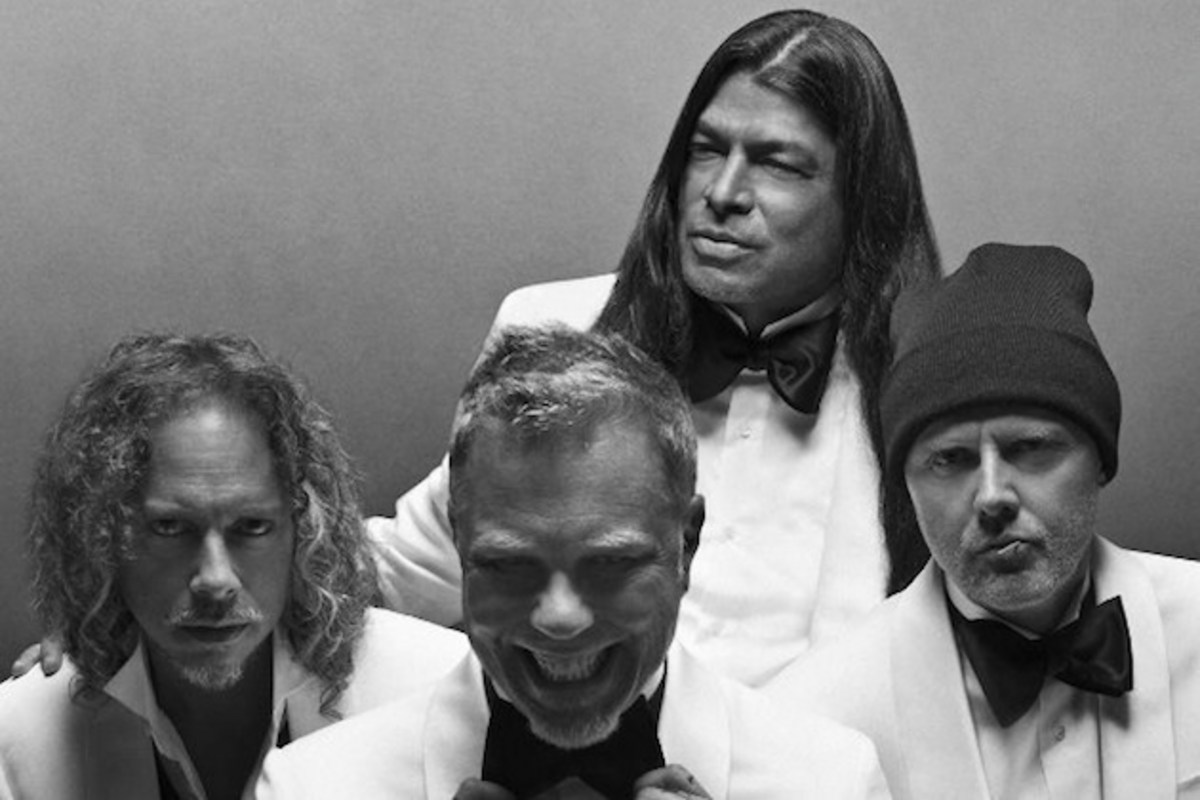
On June 29, 2016, Italian tailoring house Brioni, the label that dressed James Bond on screen, named Metallica the face of its new campaign. It was the first under creative director Justin O’Shea, appointed that March, who made a simple case for the band: it balanced age, cool and business. Photographer Zackery Michael shot James Hetfield, Lars Ulrich, Kirk Hammett and Robert Trujillo in San Francisco, in black and white, wearing bespoke black and white tuxedos and sunglasses from the brand’s new eyewear line. The Brioni name appeared in a gothic typeface that revived the logo the house used from 1955 into the ’80s.
After a social media rollout, the images went up on billboards and kiosks in Paris and ran in The New York Times, with wider print and billboard placements in New York, Los Angeles and Moscow that fall. The band said it was “beyond thrilled.” The bet didn’t last: in October 2016, just six months in and with a single collection shown, O’Shea was out at Brioni. The bond with the band survived, though, and years later O’Shea and Metallica teamed up again on a capsule sold exclusively at London’s Selfridges to mark 40 years of ‘Ride the Lightning’.
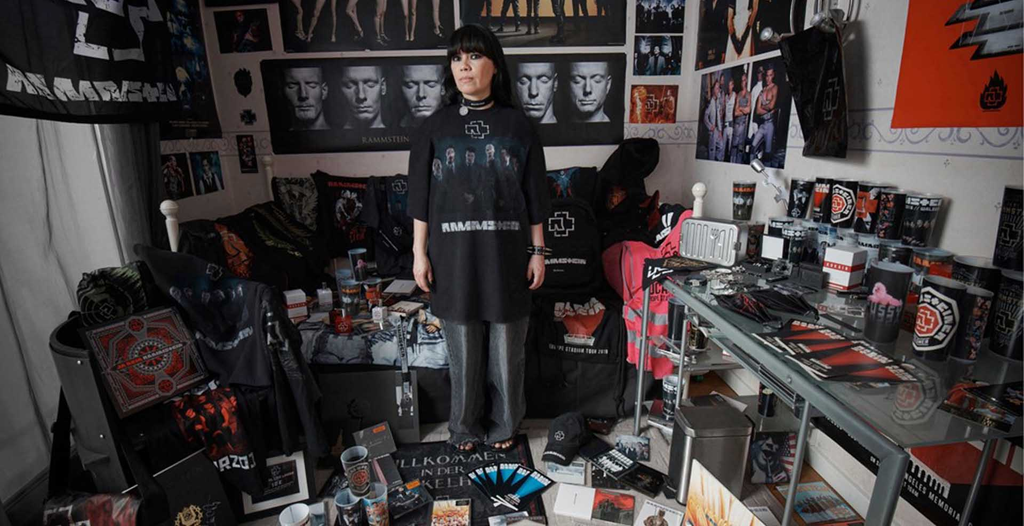
Balenciaga‘s collaboration with Rammstein, released in April 2021, had a more personal origin. Creative director Demna is an outspoken fan of the German band: he regularly wears their shirts and had added their songs to a Balenciaga playlist on Apple Music. The limited-edition unisex capsule included T-shirts, oversized hoodies, caps, fanny packs, a backpack and a raincoat, all carrying the band’s logo and unseen photos from a shoot by Gottfried Helnwein, the Austrian artist who photographed Rammstein in 1998, painted the cover of Scorpions‘ ‘Blackout’ and collaborated with Marilyn Manson on ‘The Golden Age of Grotesque’.
The casting said the most. Instead of professional models, Demna’s team reached out to Rammstein fans on Instagram and photographed them at home, surrounded by their merch and memorabilia. They included Helena Jurisch of Munich, who discovered the band through a video in 2001 and said she had “never heard anything like this before,” and Torsten Gäbler of Dresden, who first heard them in 1996 and had seen them live 21 times. The contrast was hard to miss: people who had spent decades buying the band’s merch were modeling luxury-priced pieces, at $495 for a cap, $995 for a hoodie and $2,250 for the raincoat. Rammstein curated its own Apple Music playlist for the launch.
Manchester-based luxury streetwear label Represent, founded by brothers George and Mike Heaton, took the idea further. On April 24, 2024, it released a 19-piece Metallica capsule of T-shirts, leather jackets and hoodies built around the 40th anniversary of ‘Ride the Lightning’, with nods to ‘Master of Puppets’, ‘…And Justice for All’ and ‘Garage Inc.’ “Today, we showcase a true collaboration, not just a licensing deal,” Mike Heaton said. In June 2025 it followed with Iron Maiden: 18 pieces for the band’s 50th anniversary, built around Eddie and the artwork for ‘Killers’, ‘The Number of the Beast’, ‘The Trooper’, ‘Holy Smoke’ and ‘Infinite Dreams’, with sun-fade washes, appliqués and distressing to recreate vintage tour shirts. It was the band’s first official fashion collaboration. “They’ve never done a fashion collaboration before,” George Heaton noted, calling it “undeniably historical.” Thirteen years after Balenciaga borrowed its lettering, Iron Maiden finally had a luxury line of its own.
Enfants Riches Déprimés: The Musician as Part of the Work
Enfants Riches Déprimés, French for “depressed rich kids,” represents the newest stage in this story. Artist Henri Alexander Levy founded it in Los Angeles in 2012, right after finishing fine art studies at UCLA, and its aesthetic draws on punk, outsider art and Jean Dubuffet‘s art brut, with themes of repression, psychological pressure and childhood. Production is limited and handmade, in exotic skins, hand-cast silver and cashmere, and Levy describes it as making “isolating objects,” pieces that are “super specific, super niche.”
The label has always moved between fashion and the art world. It first showed in Paris in September 2016, became the first fashion house to present at Christie’s Paris in June 2017, and showed its Spring/Summer 2025 collection at Sotheby’s Paris in September 2024. It opened its first Paris boutique on Rue Charlot in the Marais in 2019, added a second flagship in Seoul in 2025, and in 2026 announced a New York store in TriBeCa.
Rock has been in its orbit from the start. Courtney Love and her daughter Frances Bean Cobain are among its followers, and Love attended the 2023 opening of ‘Orphaned Works’, an exhibition by Levy. In October 2025, New York punk pioneer Richard Hell, of Television and The Voidoids, widely credited with originating much of punk’s look with his ripped shirts and spiked hair, walked in the Spring/Summer 2026 show at the Hôtel de Maisons.
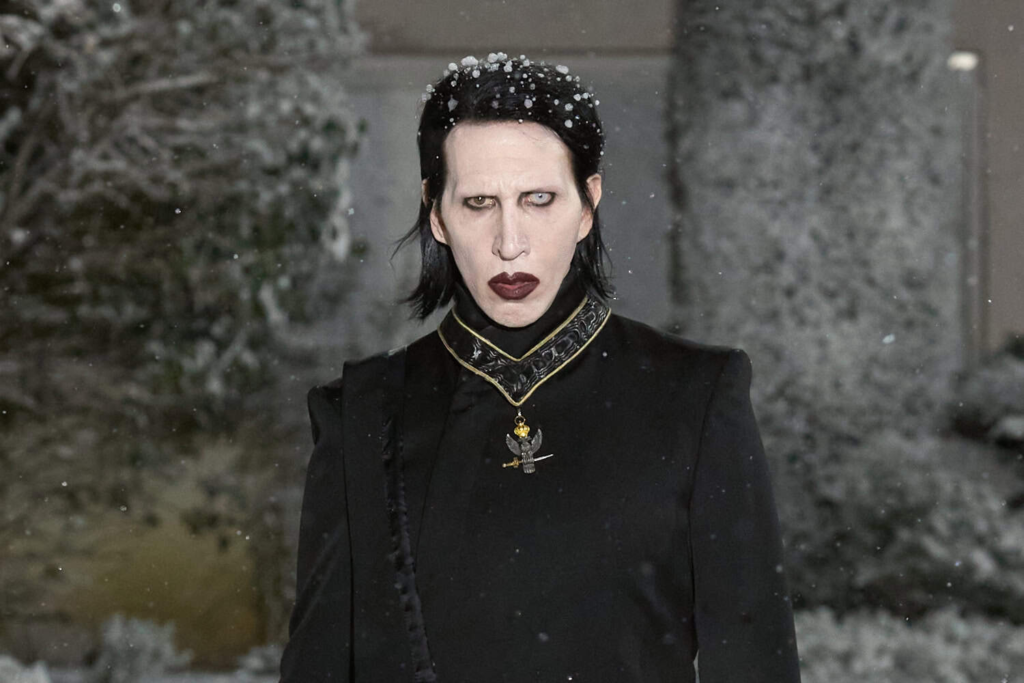
On March 8, 2026, Marilyn Manson opened the Fall/Winter 2026 show at Paris’s Maison de la Chimie. The 37-look collection, presented under artificial snow, featured striped suits, parkas and head-to-toe leather with an almost military discipline. Manson performed a spoken version of ‘Cryptorchid’, from ‘Antichrist Superstar’, over an instrumental by Irish band Virgin Prunes. His appearance drew criticism because it came as he faces sexual assault allegations, which he has denied. Unlike the campaigns of the previous decade, Manson wasn’t there as an ad face, but as part of the show itself.
What Changed in Fifty Years
Taken as a whole, the relationship between high fashion and rock has gone through three stages. In the first, Kansai Yamamoto’s and Vivienne Westwood’s, designer and musician built an identity from scratch, and the clothes were inseparable from the music. In the second, McQueen’s, Slimane’s, Saint Laurent’s and Gucci’s, the big houses adopted rock’s silhouette and attitude and turned its stars into ambassadors. In the third, Brioni’s, Balenciaga’s and Represent’s, metal, the genre fashion ignored or looked down on for decades, became a business partner, with official collaborations, licensing and luxury price tags.
Each stage left its tensions. The band shirts fans once bought for a few bucks at the merch table came back as hoodies costing nearly a thousand dollars, and Rammstein’s own fans ended up modeling them. At the same time, those deals gave bands visibility well beyond their usual audience and confirmed something metal always knew: its iconography, from Eddie to Bathory’s lettering, is as recognizable as any luxury monogram.
In a way, the story ends where it began. The coat Bowie called “the ultimate anti-icon” now belongs to the V&A, the same museum that holds Kansai’s jumpsuit; Westwood’s shop is still open on King’s Road under the name it took in 1980; Eddie hangs on the racks at Selfridges. Clothes made to provoke have become heritage, and labels like Enfants Riches Déprimés are now trying to recover that first idea: that a musician shouldn’t just be the face of a brand, but part of the work.